“Smart Home Water Management: Future of Sustainable Living”
Smart Home Water Management: The Future of Sustainable Living
Water is one of our most precious resources — yet households unknowingly waste gallons daily. Discover how smart water systems monitor every drop, detect leaks instantly, and automate conservation for you.
Smart home water management uses IoT sensors, automated valves, and smartphone apps to monitor usage, detect leaks, and control water flow automatically. Top devices include the Flume 2 (best budget monitor), Phyn Plus (best whole-home protection), and Rachio (best smart irrigation). Most systems reduce household water bills by 15–30% and pay for themselves within 1–2 years.
What Is Smart Home Water Management?
Smart home water management refers to the integration of advanced technologies — including IoT sensors, automated valves, and cloud-connected apps — to monitor and control water usage throughout your home. These systems provide real-time consumption data, detect leaks the moment they occur, and can even shut off your water supply automatically before damage spreads.
Unlike traditional plumbing systems that offer zero visibility into daily usage, a smart home automation ecosystem gives homeowners complete transparency. You can see exactly how much water your dishwasher, shower, or irrigation system uses — down to the gallon — and receive instant alerts on your smartphone when anything looks unusual.
According to the U.S. Environmental Protection Agency (EPA), the average American household wastes nearly 10,000 gallons of water per year from leaks alone — enough to fill a backyard swimming pool. Smart water leak detectors catch these losses before they become costly problems.
Why Smart Water Solutions Matter in 2026
With global water scarcity worsening and household utility bills rising, smart water solutions have shifted from luxury upgrades to practical necessities. The four core benefits make a compelling case for every homeowner. If you are budgeting for multiple upgrades, our room automation cost guide breaks down the full investment across every smart home system.
Best Smart Home Water Monitoring Devices 2026
Smart water monitors clip onto your existing meter or pipes and track every drop flowing through your home. Here are the three top-rated options for 2026:
The Flume 2 attaches to your existing outdoor water meter in minutes — no pipe cutting, no plumber required. It uses radio frequency signals to read your meter every second and delivers real-time usage data to the Flume app. Leak alerts, budget tracking, and usage breakdowns by fixture make this the most user-friendly smart water monitor available.
- No pipe cutting required
- Real-time per-second monitoring
- Fixture-level usage breakdown
- Budget alerts & leak notifications
- No automatic shut-off valve
- Requires compatible water meter
- Bridge device needed (included)
StreamLabs uses ultrasonic technology to detect water flow through your pipe without cutting into it. It clamps around your pipe and measures flow using sound waves, making it compatible with virtually any pipe type. The StreamLabs app provides real-time alerts, detailed water use reports, and comparisons with similar households.
- Works on any pipe type
- No meter compatibility issues
- Household comparison reports
- Less granular than Flume 2
- No automatic shut-off
The Phyn Plus is the most comprehensive smart water monitor available — it installs inline on your main water supply line and uses high-definition pressure wave analysis to detect even the smallest leaks. Crucially, it includes an automatic shut-off valve that closes instantly when a major leak is detected, protecting your home from flooding even when you are away.
- Automatic main line shut-off
- Highest leak detection accuracy
- Detects micro-leaks in pipes
- Remote control via app
- Requires professional installation
- Higher upfront cost
Water-Efficient Appliances & Smart Faucets
Beyond monitoring, replacing outdated fixtures with water-efficient alternatives delivers permanent savings with no ongoing management required.
Moen Eco-Performance Faucets
Moen’s Eco-Performance line reduces water flow to 1.2 gallons per minute — 32% less than the standard 1.8 GPM — without any noticeable reduction in pressure or performance. The integrated air infusion technology mixes air into the water stream, maintaining a full, satisfying flow at lower volume. Compatible with the Moen Smart Water Network app for usage monitoring.
Water-Efficient Dishwashers
Modern Energy Star-certified dishwashers use 3–4 gallons per cycle, compared to 10–15 gallons for older models and 27 gallons for hand-washing a full load. If your dishwasher is more than 10 years old, replacing it with an Energy Star model saves both water and electricity costs significantly.
Installing a smart showerhead with a built-in flow meter can reduce shower water use by 20–30%. Models from Moen and Kohler connect to home automation systems and alert you when shower time exceeds your set threshold.
Smart Irrigation Systems for Lawns & Gardens
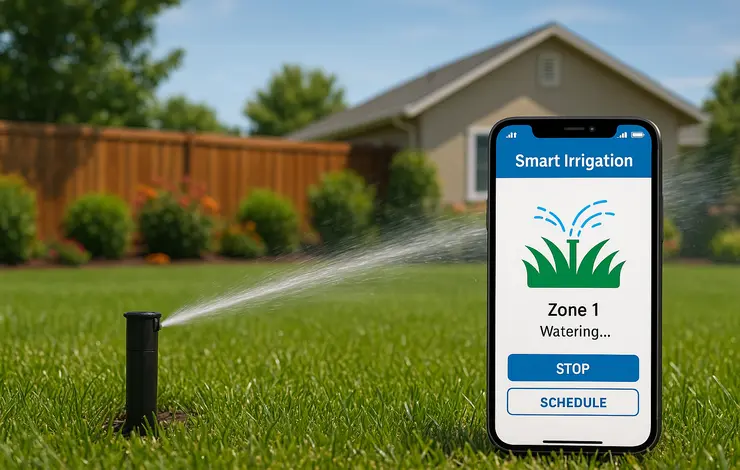
Outdoor watering accounts for up to 30% of total household water use — and much of it is wasted through overwatering, evaporation, and running sprinklers before rain. Smart irrigation controllers solve this completely. At a larger scale, the same water conservation principles apply in farming — see our guide to precision agriculture sensors for farmers.
Rachio replaces your existing sprinkler timer and connects to your Wi-Fi and local weather data. It automatically skips watering cycles when rain is forecast, adjusts schedules based on seasonal temperature changes, and uses soil moisture estimates to determine exactly how much water each zone needs. Rachio is EPA WaterSense certified and reduces outdoor water use by up to 50% compared to conventional timer-based systems.
- Automatic rain skip & freeze protection
- Easy DIY installation (45 min)
- Works with Alexa, Google, HomeKit
- EPA WaterSense certified
- Requires existing irrigation system
- Advanced features need Wi-Fi
Top Smart Home Water Automation Systems
Full smart home water automation systems go beyond monitoring — they combine sensors, automated valves, and smart controllers to manage water flow throughout your entire home without manual intervention.
YoLink FlowSmart combines ultrasonic water metering with an automated valve controller in a single system. When a leak or abnormal flow is detected, it instantly closes the valve to stop water flow. YoLink uses LoRa wireless technology, which means it works reliably even when Wi-Fi goes down — critical for emergency shut-off during internet outages.
DROP is the most comprehensive whole-home water management platform available, combining leak detection, water softening control, filtration monitoring, and automated shut-off in a single connected system. It is ideal for homeowners who want a complete solution covering water quality and conservation in one platform.
Step-by-Step Guide to Setting Up Smart Water Management
Getting started with a smart home water system does not require a complete plumbing overhaul. Follow these five steps to build an effective system progressively:
Smart Water Monitoring Apps: Control at Your Fingertips
Every smart water device comes with a dedicated app, but the best platforms go far beyond simple on/off controls. Here are the top apps to know:
- Real-time leak detection alerts
- Per-fixture usage breakdown
- Remote main line shut-off
- Water usage history & trends
- Integrates with Flo by Moen devices
- Real-time flow alerts
- Detailed hourly/daily reports
- Neighbour comparison feature
- Budget goal setting
- Alexa & Google integration
- Second-by-second usage data
- Smart leak detection AI
- Custom usage budgets
- Monthly bill estimates
- Multi-location support
- Weather-based schedule adjustment
- Zone-by-zone control
- Water usage reports
- Seasonal schedule optimization
- Voice assistant support
Frequently Asked Questions — Smart Home Water Management
Ready to Stop Wasting Water?
Start with one smart monitor and see exactly where your water is going. Most homeowners are surprised by what they find — and the savings follow quickly.
Explore All Home Automation Guides →