Smart Home Pros and Cons: Complete 2026 Guide to a Fully Automated Home
Smart Home Pros and Cons: Complete 2026 Guide to a Fully Automated Home
A balanced, expert-reviewed breakdown of every advantage and disadvantage before you invest in home automation.
The biggest smart home benefits are energy savings (10–23% annually on HVAC), stronger security, remote monitoring, daily convenience, and higher property value. The main drawbacks are high upfront cost ($5K–$50K+ for full systems), complete internet dependency, privacy risks from data-collecting devices, cross-brand compatibility issues, and ongoing subscription fees of $60–$120/month. For homeowners staying 5+ years, the smart home pros and cons balance clearly favors investment when planned correctly.
What Is a Fully Automated Home?
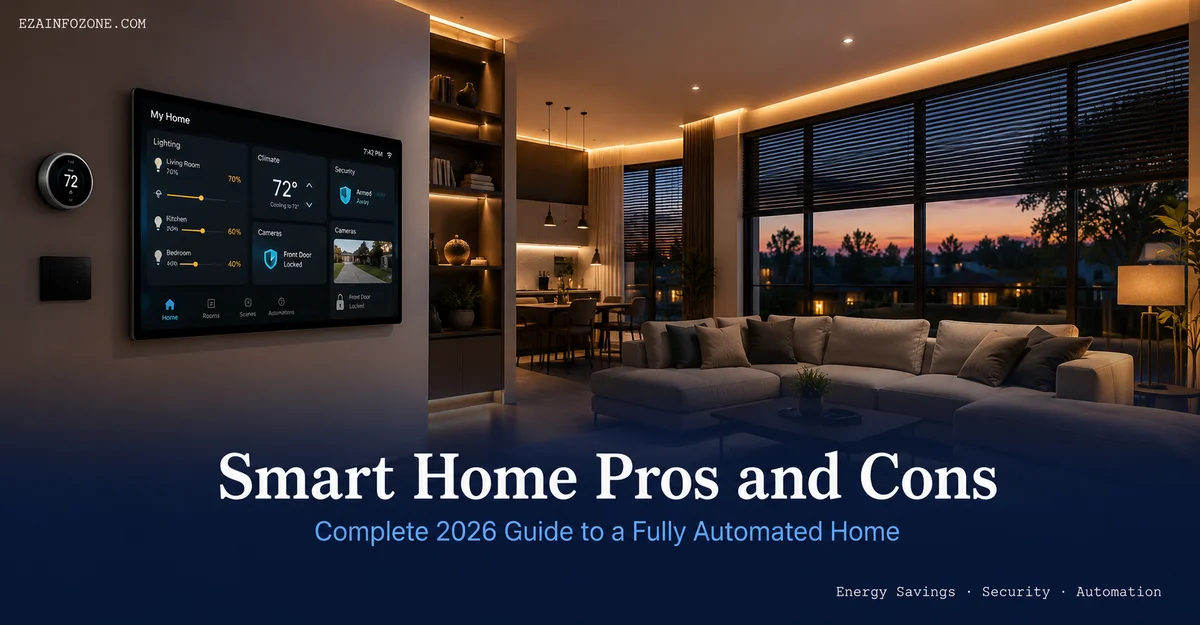
A fully automated home connects lighting, heating and cooling, security, appliances, and entertainment into a single controllable network. Smart devices communicate through a central hub and respond to voice commands, app controls, schedules, and motion sensors — often without any manual input at all.
Full automation ranges from a minimal setup — a smart thermostat, a few smart bulbs, and a video doorbell — to a comprehensive system covering every room and device. Most households operate somewhere between these two extremes. The complete home automation guide on this site shows what a full-scale setup looks like in practice and what it realistically costs.
Regardless of scale, the promise is the same: less daily effort, more control, and a home that adapts to your life. Whether that promise actually delivers depends on the smart home pros and cons specific to your situation, budget, and lifestyle — which is exactly what this guide breaks down.
- Real energy and utility savings
- Remote monitoring and control anywhere
- Stronger home security and safety
- Daily convenience through automation
- Increased property resale value
- Aging-in-place independence
- Fully customizable routines
- High upfront installation cost
- Total internet dependency
- Privacy and data security risks
- Cross-brand compatibility issues
- Technical setup complexity
- Ongoing subscription fees
- Technology obsolescence risk
Smart Home Benefits — The Pros of Full Automation
The smart home benefits are measurable, well-documented, and felt daily. When you weigh the full smart home pros and cons, the advantages below consistently rank as the reasons homeowners invest — and stay invested. Here is what a fully automated home actually delivers when set up correctly.
1. Real Energy Savings
Smart thermostats reduce HVAC costs by 10–23% annually according to independent studies. Smart lighting that auto-dims or shuts off in empty rooms compounds those savings further. A well-configured automated home delivers measurable smart home energy efficiency with zero daily effort. This is one of the most financially concrete smart home benefits you will see from the first billing cycle.
2. Remote Control and Real-Time Monitoring
Check your security cameras, lock the front door, or adjust the thermostat from anywhere in the world through a smartphone app. Remote access is one of the top smart home benefits for busy households, frequent travelers, and rental property owners. Forget to turn off the oven before a flight? Verify and fix it remotely in seconds. This smart home benefit alone justifies the investment for many households.
3. Significantly Stronger Home Security
Automated security systems combine motion sensors, smart locks, video doorbells, and AI-powered cameras into a unified defense layer. They deliver real-time alerts, record events automatically, and deter opportunistic break-ins far more effectively than traditional alarms. See the best home security systems for 2026 to compare what is available at each price point.
4. Daily Convenience and Time Savings
A morning routine that automatically raises blinds, starts the coffee maker, and adjusts the thermostat saves 15–20 minutes every day — nearly 100 hours per year. Automated routines handle repetitive tasks invisibly so you can focus on what actually matters. This everyday convenience is a key reason the smart home pros and cons debate consistently favors adoption for households with busy schedules.
5. Measurable Increase in Property Value
A professionally installed smart home system adds documented resale value. Consumer research from 2025–2026 shows homebuyers actively seek smart-ready properties, and homes with integrated automation sell faster at premium prices. This makes smart home investment one of the few improvements that consistently returns more than it costs when it comes time to sell — a key factor in the smart home pros and cons calculation for long-term homeowners.
6. Accessibility and Aging in Place
For seniors and people with mobility limitations, home automation is transformative — not just convenient. Voice-controlled lights, automatic locks, fall-detection sensors, and remote-access features give older adults independence and safety that manual systems cannot replicate at any price. The smart home benefits in this category are especially significant for multigenerational households.
7. Customizable Automation for Any Lifestyle
Modern platforms support conditional logic: “if motion detected in hallway after 10 PM, turn on pathway lights at 30% brightness.” This granular control means the system works for your exact routines, not a generic template. Routines update as your life changes without replacing hardware. Personalization at this level is a smart home benefit that conventional homes simply cannot match.
Smart Home Disadvantages — The Cons You Need to Know
An honest evaluation of the smart home pros and cons requires addressing the limitations without minimizing them. These are genuine drawbacks that affect real users — and no balanced smart home pros and cons guide should stop at the benefits alone.
1. High Upfront Cost
A comprehensive automated home — covering lighting, HVAC, security, and appliances — costs between $5,000 and $50,000+ depending on size and complexity. Even a mid-range setup requires meaningful investment. Budget-friendly smart home devices exist, but a fully integrated system with professional installation is a financial commitment many households underestimate at the planning stage.
2. Complete Internet Dependency
Most smart home devices require stable internet for full operation. When the connection drops — or a cloud service goes down — lights stop responding, smart locks behave unpredictably, and routines fail silently. This is one of the most practical smart home disadvantages for households in areas with unreliable broadband or for anyone who wants zero single points of failure.
3. Privacy and Cybersecurity Risks
Smart devices collect data continuously — daily routines, voice commands, camera feeds, energy usage patterns, and access logs. Unsecured IoT devices are a documented attack surface, with smart home vulnerabilities increasing sharply in 2024–2025. Understanding how to protect your smart home from hackers is essential before deploying a large automated system. Privacy risk is the most serious of all smart home disadvantages because the consequences of a breach are immediate and personal.
4. Device Compatibility Problems
Not all smart devices work with all ecosystems. A Google Home device may not integrate with Apple HomeKit. A Zigbee sensor may not pair with a Z-Wave hub. The Matter standard (launched 2023) is improving cross-brand compatibility, but fragmented ecosystems remain a common frustration for users building out a full smart home in 2026.
5. Setup Complexity and Ongoing Maintenance
A fully automated home is not plug-and-play. Network configuration, hub setup, device pairing, routine building, and ongoing troubleshooting require genuine technical patience. Firmware updates can break integrations. For non-technical users, the maintenance burden of a large smart home system is a real and persistent cost that continues well after the initial setup.
6. Subscription Fees Accumulate
Major platforms — Ring, Google Nest, Arlo, SimpliSafe — charge monthly fees for cloud storage, advanced features, and professional monitoring. A household running five subscription-based devices can pay $60–$120 per month in platform fees on top of the hardware cost. Over three years, those fees often exceed the original device price. These recurring costs are one of the most frequently overlooked smart home disadvantages.
7. Technology Obsolescence
Smart home hardware and platforms evolve rapidly. Devices purchased in 2021–2022 may have already lost manufacturer support or stopped receiving security updates. Investing heavily in one ecosystem creates lock-in risk if that platform changes its pricing or business model. The smart home advantages and disadvantages calculation shifts significantly when you factor in 5–10 year replacement cycles.
Smart Home Pros and Cons: Comparison Table
Use this table as a quick reference for every major smart home pros and cons factor. Each row shows the concrete benefit, the real limitation, and a practical verdict.
| Factor | Smart Home Benefit | Limitation | Verdict |
|---|---|---|---|
| Energy Costs | 10–23% annual HVAC savings; automated lighting cuts waste | Hardware cost takes 2–3 years to recoup | ✓ Worth it long-term |
| Security | Real-time alerts, AI cameras, smart locks, automated responses | Vulnerable to cyberattacks if improperly secured | ✓ Net positive with setup |
| Convenience | Automated routines eliminate daily repetitive tasks | Initial setup time and ongoing maintenance | ✓ Strong long-term value |
| Privacy | You control access and what is monitored | Devices collect behavioral data; breach risk is real | ⚠ Manage actively |
| Upfront Cost | Adds measurable property resale value | $5K–$50K+ for a comprehensive system | ⚠ Requires budget planning |
| Reliability | Redundant alerts, backups, local control options | Fully dependent on internet and cloud | ⚠ Stable broadband required |
| Property Value | Faster sale, higher asking price in most markets | Only adds value if buyers also want automation | ✓ Positive in 2026 market |
| Accessibility | Life-changing for seniors and people with disabilities | Initial configuration requires technical help | ✓ Strong net positive |
| Subscriptions | Cloud features and monitoring justify cost for many | $720–$1,440/year ongoing across 5 platforms | ⚠ Audit all fees upfront |
Who Should Consider a Fully Automated Home?
The smart home pros and cons balance sheet looks different depending on your circumstances. Full home automation delivers its best return for specific types of households.
Best candidates for full automation: Homeowners planning to stay 5+ years have the time to recoup upfront costs and fully benefit from the investment. Households with high energy bills see immediate ROI from automated HVAC and lighting. Families with young children or elderly relatives get real safety value from remote monitoring and automated security. Frequent travelers benefit from remote access and real-time alerts. Tech-comfortable users willing to invest in setup get the most from advanced routines.
Less suitable scenarios: Renters who cannot make permanent installations, households planning to move within 2–3 years, users with low tolerance for technical troubleshooting, and homes in areas with unreliable internet will find the smart home disadvantages outweigh the benefits in most categories.
A selective approach — targeting the three highest-impact devices — often delivers 80% of the smart home benefits at 20% of the cost and complexity. This phased strategy captures the core smart home benefits without requiring full-scale installation from day one. It is the starting point most experts recommend.
Start with three devices. A smart thermostat (energy savings), a smart lock (access and security), and a video doorbell (real-time monitoring) cover the three most valuable automation categories. Get comfortable with these before expanding. The smart home guide for 2026 provides a practical room-by-room expansion framework from this starting point.
How to Get Started Without Overspending
Knowing the smart home pros and cons is the first step. Getting started without wasting money on the wrong devices requires a structured approach based on your actual household needs — not on the full feature set of every device on the market.
Step 1 — Choose your ecosystem before any device. Commit to Amazon Alexa, Google Home, or Apple HomeKit before purchasing anything. Every device you buy must work natively within that ecosystem. Cross-ecosystem workarounds create compatibility problems and maintenance headaches that erode the convenience benefits of automation.
Step 2 — Buy your three high-impact devices first. Smart thermostat, smart lock, and video doorbell. These three cover energy efficiency, physical security, and access control — the categories with the clearest, fastest return on investment. Master these before adding complexity.
Step 3 — Secure your network before connecting anything. Change default router credentials, enable WPA3 encryption, and create a dedicated VLAN or guest network for IoT devices, isolated from your main computers and phones. Smart home cybersecurity must be configured before devices go live, not retrofitted after a problem occurs.
Step 4 — Add devices in layers over time. Smart lighting, smart plugs, and environmental sensors can be added one room at a time across several months. This approach distributes cost, avoids configuration overwhelm, and gives you time to understand each category before committing to a brand.
Step 5 — Calculate total cost of ownership before buying. Before choosing any security camera or monitoring platform, confirm the complete monthly fee including cloud storage, monitoring tiers, and premium features. A device that costs $60 upfront but requires a $10/month subscription costs $420 in the first three years. The subscription cost often matters more than the device price tag.
Frequently Asked Questions
Ready to Start Your Smart Home Journey?
You now have the full smart home pros and cons picture. Start with the right devices, the right ecosystem, and a clear budget. Our complete guides cover every category.
Explore the Full Smart Home Guide →