Energy Savings Devices 2026: 10 Ways to Cut Your Electricity Bill by 30%
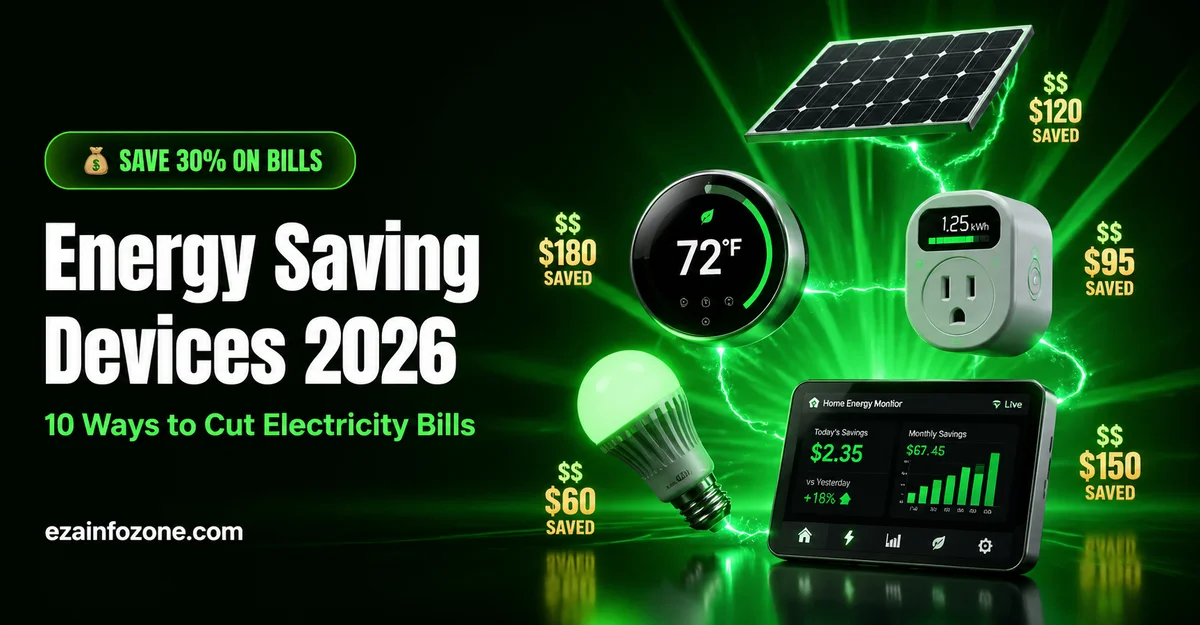
Energy Saving Devices 2026:
10 Ways to Cut Bills by 30%
The best home energy saving devices tested and ranked — smart plugs, energy saving light bulbs, thermostats and more. Real savings, real numbers.
Best energy saving devices 2026: Smart thermostat (saves $131–$145/yr), energy saving LED bulbs (75% less power, ~$8/bulb), and smart plugs with energy monitoring (eliminate $100–$200/yr in standby waste). These 3 devices cost ~$210 total and pay back in under 12 months. Combined savings from all 10 devices: $480–$885/year.
How Much Can Energy Saving Devices Really Cut Your Bill?
Energy saving devices are the fastest, most cost-effective way to reduce your home electricity bill in 2026. The average American household spends $1,500–$2,200 per year on electricity — and studies consistently show that the right combination of home energy saving devices can cut that bill by 25–30% without any sacrifice in comfort.
This is not theory. The US Department of Energy confirms that smart thermostats alone save 10–15% on heating and cooling costs annually. Energy saving LED light bulbs use 75% less power than traditional incandescent bulbs. Smart plugs eliminate the “vampire power” drain that accounts for 10% of most home electricity bills. Combined, these energy saving ideas deliver real, measurable results every single month.
This guide covers the 10 best home energy saving devices in 2026 — what they cost, how much they save, and exactly which ones to buy first for the fastest return on your investment.
Average Annual Savings — All 10 Devices Combined
Based on average US household electricity usage at $0.16/kWh — your actual savings depend on usage and local rates.
1. Smart Thermostat — The #1 Energy Saving Device
A smart thermostat is the single highest-ROI energy saving device you can buy in 2026. Heating and cooling accounts for 43% of the average US home electricity bill — making your HVAC system the biggest target for energy saving ideas that actually move the needle.
Unlike a traditional thermostat that blindly follows a schedule you set once and forget, a smart thermostat learns your daily patterns automatically. It knows when you wake up, when you leave for work, when you return, and when you go to sleep — and adjusts temperature accordingly without you touching it. When you forget to turn off the AC before leaving for vacation, your phone does it for you.
The Google Nest Learning Thermostat, the most studied smart thermostat on the market, delivers an average saving of $131–$145 per year according to independent studies — paying for itself in under two years. The Ecobee SmartThermostat Premium adds room sensors that detect which rooms are actually occupied and heat or cool only those spaces, adding another layer of energy saving on top.
💰 Annual Savings: $131–$145 | Payback Period: 18–24 months| Smart Thermostat | Price | Annual Savings | Best For |
|---|---|---|---|
| Google Nest Learning | ~$130 | $131–$145 | Best Overall |
| Ecobee SmartThermostat | ~$220 | $140–$160 | Room Sensors |
| Google Nest Thermostat | ~$80 | $100–$120 | Budget Pick |
| Honeywell T9 | ~$150 | $110–$130 | Multi-Zone |
2. Energy Saving Light Bulbs — 75% Less Power Instantly
Energy saving light bulbs are the easiest, cheapest, and most immediate energy saving device you can install. No setup, no app, no hub required — just screw them in and your lighting electricity consumption drops by 75% instantly. Every incandescent bulb still in your home is costing you money every single day.
A traditional 60-watt incandescent bulb running 3 hours per day costs approximately $3.50 per year in electricity. An equivalent 9-watt energy saving LED bulb doing the same job costs just $0.88 per year — a saving of $2.62 per bulb annually. For a home with 20 bulbs, that is $52 per year in savings from a one-time purchase costing $60–$80 total.
In 2026, energy saving bulbs have advanced far beyond simple white light. Smart LED energy saving bulbs from brands like Sengled, WiZ, and Govee add voice control, color changing, automated schedules, and motion-activated lighting on top of the energy savings — turning a simple energy upgrade into a full smart home feature.
💰 Annual Savings: $50–$100 for whole home | Cost: $60–$80 for 20 bulbsSengled Smart LED
Best budget energy saving bulb. 800 lumens. Works with Alexa and Google.
Saves 75% vs incandescentWiZ Color LED
Energy saving + 16M colors. Matter compatible. No hub needed.
~$15 eachPhilips Hue White
Premium energy saving bulb. 25,000 hour lifespan. Best build quality.
Lasts 22+ yearsKasa KL125
Tunable white energy saving bulb. Warm to cool daylight. Matter certified.
~$12 eachBuy energy saving bulbs in 4-packs — cost drops to $7–$8 per bulb. Sengled 4-pack at ~$28 is the best value energy saving light bulb purchase in 2026. Replace your 5 most-used lights first — kitchen, living room, bedroom — for the fastest savings.
3. Smart Plugs — Eliminate Vampire Power Waste
Smart plugs are one of the most underrated energy saving devices available. The problem they solve is called “vampire power” or standby power — the electricity that devices consume even when switched off or in sleep mode. According to the Lawrence Berkeley National Laboratory, standby power accounts for 10% of residential electricity use in the USA — roughly $100–$200 per year for the average household.
Smart plugs with energy monitoring show you exactly how much electricity each appliance draws in real time. When you discover that your old TV uses 40 watts on standby, your games console uses 150 watts even when idle, and your cable box runs 24/7 at 17 watts — you can schedule those devices to completely power off overnight and when you leave home, cutting their electricity consumption to zero during those hours.
The TP-Link Kasa EP25 at ~$17 is the best smart plug energy saving device in 2026 — it is Matter certified, supports per-outlet energy monitoring, and works with Alexa, Google Home, and Apple HomeKit simultaneously. Buy four and place them on your TV, gaming console, home office equipment, and kitchen appliances for maximum smart plug energy saving impact.
💰 Annual Savings: $100–$200 | Cost: $40–$70 for 4 plugs4. Smart Power Strips — Control Whole Device Groups
A smart power strip takes the concept of a smart plug and multiplies it — giving you individual control over 4–6 outlets simultaneously from a single device. This makes it the ideal energy saving device for entertainment centers, home offices, and kitchen countertops where multiple appliances cluster together.
The real energy saving magic of smart power strips is the “master-controlled outlet” feature. When your TV (plugged into the master outlet) turns off, the power strip automatically cuts power to your soundbar, gaming console, and streaming stick as well — all in one action. No more forgetting to turn off peripheral devices that silently drain power all night.
The Kasa EP40A smart power strip at ~$35 offers individual outlet monitoring, surge protection, and full Alexa and Google integration — making it one of the best value energy saving devices for home offices and living rooms in 2026.
💰 Annual Savings: $50–$80 | Cost: $30–$50 per stripPlace a smart power strip behind your TV setup and another at your home office desk. Create an Alexa routine: “Goodnight” turns off both strips automatically at 11pm — eliminating all standby power from your two biggest device clusters overnight.
5. Whole-Home Energy Monitor — See Everything in Real Time
A whole-home energy monitor is the most powerful energy saving device for homeowners who want complete visibility into their electricity usage. Rather than measuring individual devices one at a time, a home energy monitor installs directly in your electrical panel and tracks every circuit in your home simultaneously — showing you exactly where your electricity is going, in real time, 24 hours a day.
The Sense Home Energy Monitor at ~$300 uses machine learning to automatically identify individual appliances by their electrical signature — it can tell when your refrigerator compressor kicks on, when your dryer is running, and when your water heater is heating. Within two weeks of installation, most users discover 3–5 appliances they had no idea were using so much power.
For smaller budgets, the Emporia Vue 3 at ~$150 monitors up to 16 individual circuits and provides real-time usage data through a clean app — making it the best value whole-home energy saving device available in 2026.
💰 Annual Savings: $100–$300 | Cost: $150–$3006. Energy Saving Fan — Replace AC for 90% Less Power
An energy saving fan is one of the most overlooked but most impactful home energy saving devices you can add in 2026. A central air conditioning system uses 3,000–5,000 watts per hour to cool a room. A modern energy saving fan uses just 30–75 watts — consuming 95% less electricity for the same cooling effect when conditions allow.
Smart energy saving fans in 2026 go far beyond simple speed controls. The Dyson Purifier Cool Gen1 combines air purification with cooling in one device, automatically adjusting fan speed based on detected air quality. The Haiku L Series smart ceiling fan uses a precision DC motor that is 70% more efficient than standard ceiling fan motors and integrates with Alexa, Google Home, and Apple HomeKit for full smart home control.
The energy saving strategy is simple — use your smart thermostat to raise the AC setpoint by 4°F and run energy saving fans in occupied rooms. The fans keep you comfortable at the higher temperature, and your AC runs significantly less. This single energy saving idea can cut cooling bills by 20–30% during summer months.
💰 Annual Savings: $80–$150 on cooling | Cost: $50–$300Energy saving fans only cool people — not rooms. Always turn fans off when leaving a room. A fan running in an empty room wastes electricity rather than saving it.
7. Smart Water Heater — Cut 14% of Your Energy Bill
Water heating accounts for approximately 14% of the average home’s energy bill — the third largest energy expense after HVAC and lighting. Making your water heater smarter is therefore one of the highest-impact energy saving ideas available for homeowners in 2026.
If replacing your water heater is not in the budget, a smart water heater controller like the Rheem EcoNet Smart Module (~$60) adds intelligent scheduling to your existing unit. You set it to heat water only during the 90 minutes before your typical morning shower, then again in the evening — rather than maintaining hot water 24 hours a day for an empty house. This schedule-based energy saving approach typically reduces water heating costs by 15–25%.
For those replacing their unit, the Rheem ProTerra Hybrid Heat Pump Water Heater is the most energy efficient option available — using heat pump technology to deliver the same hot water at 70% less electricity than a conventional electric water heater. It qualifies for a 30% federal tax credit under the Inflation Reduction Act, making the upfront cost far more manageable.
💰 Annual Savings: $60–$200 | Controller Cost: $60–$1008. Motion Sensor Lights — Never Pay for Empty Room Lighting
Motion sensor lights are one of the simplest and most reliable energy saving devices for reducing lighting waste. Studies show that lights are left on in unoccupied rooms for an average of 2–4 hours per day in typical households — representing pure, unnecessary electricity cost. Motion sensor lights eliminate this waste completely by turning lights on only when someone enters and automatically switching them off when the room is empty.
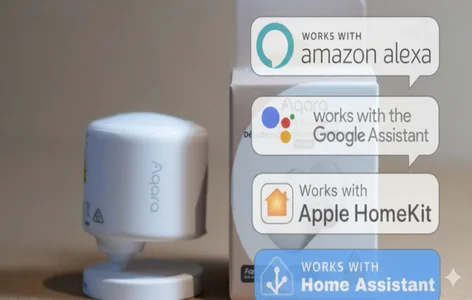
The best energy saving approach combines smart bulbs with motion sensors in an automation routine. Install an Aqara Motion Sensor P1 (~$15) in your hallway, bathroom, laundry room, and basement — the spaces most frequently left lit unnecessarily. Connect them to your smart home hub and set a 5-minute auto-off timer. These spaces can be fully automated with zero manual effort for under $100 total.
For outdoor areas, motion-activated LED security lights replace always-on floodlights that run all night — cutting outdoor lighting costs by 80% while actually improving security detection by ensuring lights only activate when there is genuine movement to detect.
💰 Annual Savings: $30–$60 | Sensor Cost: $12–$20 each9. Solar Panels + Battery Storage — Eliminate Grid Dependence
Solar panels represent the largest upfront investment in this list of energy saving devices — but also the largest long-term savings potential. A properly sized residential solar system in the USA generates enough electricity to offset 70–100% of a household’s annual electricity consumption, reducing grid electricity bills to near zero for 25+ years.
The average US residential solar installation costs $15,000–$25,000 before incentives. The 30% federal solar tax credit reduces this to $10,500–$17,500. With average electricity savings of $1,200–$1,800 per year, most homeowners reach payback in 6–10 years — then enjoy free electricity for the remaining 15+ years of the system’s life.
In 2026, smart home integration makes solar panels even more valuable as energy saving devices. When paired with a home battery like the Tesla Powerwall 3 or Enphase IQ Battery, your smart home automation system can prioritize using stored solar energy during peak rate hours and draw from the grid only during the cheapest overnight periods — maximizing savings on top of generation.
💰 Annual Savings: $1,200–$1,800 | Payback: 6–10 yearsThe 30% federal solar tax credit (ITC) is available through 2032 for US homeowners. Many states add additional rebates of $500–$5,000. Always get 3 quotes from certified installers and check your state’s DSIRE database for local incentives before purchasing.
10. Smart Home Automation — Set It and Forget the Savings
Smart home automation ties all your energy saving devices together into a system that saves electricity automatically — without you thinking about it once it is set up. This is where individual energy saving ideas multiply into a comprehensive energy saving strategy that works 24 hours a day, 365 days a year.
A “Leaving Home” automation routine, triggered when your phone leaves your home’s GPS zone, can simultaneously raise the thermostat setpoint by 4°F, turn off all smart plugs, switch off all lights, and put your water heater into vacation mode — all with zero manual input. An “Arriving Home” routine reverses everything 15 minutes before you arrive so the house is perfectly comfortable when you walk in.
A “Goodnight” routine at 11pm turns off all non-essential smart plugs, dims remaining lights to 20%, lowers the thermostat 2°F for sleeping, and locks the front door — combining security and energy saving in a single automated action. These routines collectively save an estimated 15–20% on electricity bills through consistent, automatic behavior that humans simply cannot maintain manually.
💰 Additional Savings: 15–20% on top of individual device savingsTotal Annual Savings — All 10 Energy Saving Devices
Here is a realistic annual savings estimate for an average US household implementing all 10 home energy saving devices from this guide. Individual results vary based on local electricity rates, home size, and usage patterns.
💰 Annual Savings Calculator — Average US Home
Start with items 1–3 first — smart thermostat + energy saving bulbs + smart plugs. Total cost is around $210. Total annual savings is $281–$445. Payback period is under 12 months. Then add the remaining energy saving devices one at a time as your budget allows.
🛠️ Free Smart Home Energy Tools
Plan your energy saving devices setup and calculate savings before spending anything.