Ring vs Nest vs Eufy: Best Smart Doorbell 2026 — Which One Should You Buy?
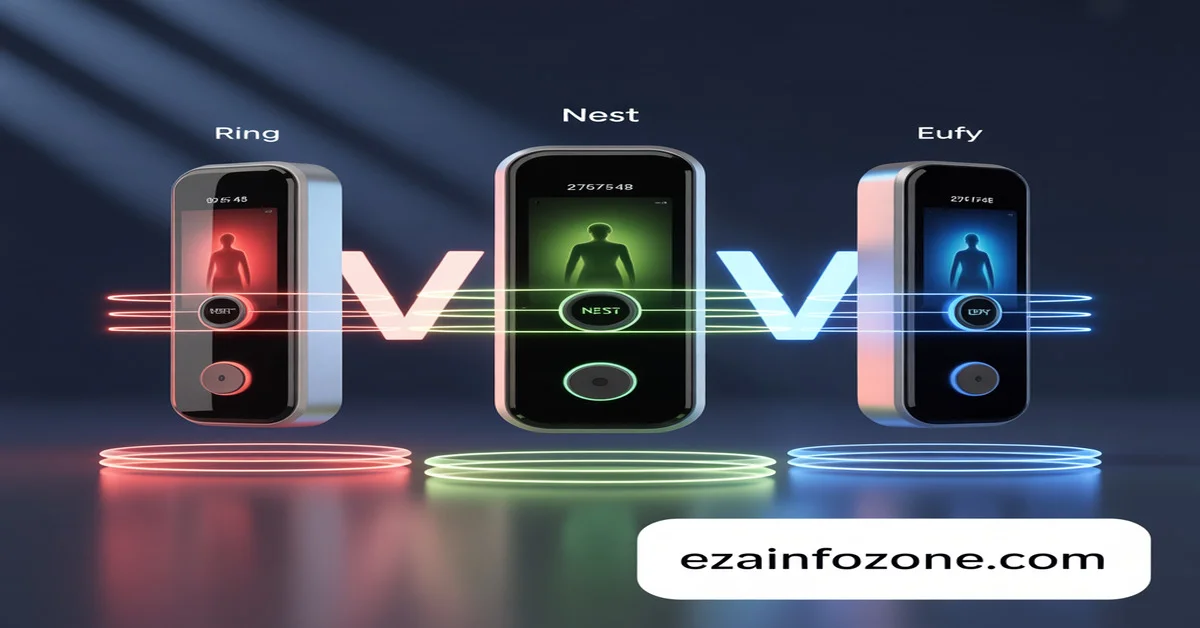
Ring vs Nest vs Eufy:
Best Smart Doorbell 2026
— Which One Wins?
Video quality, AI detection, night vision, subscription costs, and a clear winner for every type of buyer — all in one place.
Three brands dominate the smart doorbell market in 2026. Ring dominates with Alexa integration. Nest leads on AI detection. Eufy wins on privacy and zero monthly fees. But which one is right for your front door? This guide gives you a clear, honest answer.
Ring vs Nest vs Eufy 2026: Buy Ring if you use Amazon Alexa. Buy Nest if you use Google Home and want the best AI detection (Familiar Faces). Buy Eufy if you want no monthly subscription and local storage. Best overall value: Eufy Video Doorbell Dual E340 (~$160, zero ongoing fees, dual 2K cameras, best color night vision).
Three Brands, Three Philosophies
Before comparing features, it helps to understand what each brand is fundamentally trying to do. Their product decisions — from storage to AI to pricing — all flow from a core philosophy that shapes the entire experience.
Ring announced three new battery-powered video doorbells in late March 2026, expanding its already large lineup with more affordable options. The Nest Doorbell reached its third generation with a significant jump to 2K resolution. Eufy continues to refine its dual-camera system and on-device AI, reinforcing its position as the subscription-free leader.
max resolution
resolution
dual cameras
subscription fee
Ring vs Nest vs Eufy — Full Feature Comparison
Here is every important spec side by side. Pay special attention to the subscription row — it is the single biggest factor in your long-term cost.
| Feature | Ring | Google Nest | Eufy |
|---|---|---|---|
| Best Model 2026 | Battery Doorbell Plus | Nest Doorbell 3rd Gen | Video Doorbell Dual E340 |
| Video Resolution | 4K (wired Pro) | 2K HDR | Dual 2K |
| Field of View | 1:1 head-to-toe | 166° wide | Head + downward cam |
| Night Vision | Color (premium) | Infrared + HDR | Color spotlight — best |
| AI Detection | Person + package | Person + vehicle + animal | Person + package + face |
| Monthly Subscription | $4.99–$10/month | $6–$12/month | $0 — none needed |
| Free Video Storage | None (live view only) | 3 hours event history | Local storage — unlimited |
| Storage Type | Cloud (subscription) | Cloud (subscription) | Local HomeBase |
| Battery Life | 3–6 months | 2–2.5 months | Up to 6 months |
| Alexa Integration | Native — best | Limited | Works |
| Google Home | Limited | Native — best | Works |
| Apple HomeKit | No | No | Yes |
| Works Without Internet | No | No | Yes — local storage |
| Installation | Easiest — beginner | Moderate | Easy (HomeBase setup) |
| Starting Price | ~$100 | ~$130 | ~$100 |
| 3-Year Total Cost | $280–$460+ | $346–$562+ | ~$100–$200 (one-time) |
Ring Doorbell 2026 — The Alexa Powerhouse
Ring is the most recognizable doorbell brand in the world for good reason. Its integration with Amazon’s ecosystem is unmatched — if you already own Echo devices, a Ring Protect subscription, or a Ring Alarm system, adding a Ring doorbell feels completely seamless. You can view live footage on Echo Show displays, get Alexa announcements when someone rings, and manage everything through a single app.
The new 2026 lineup introduced in late March expands Ring’s battery-powered options at more competitive price points. The flagship Ring Wired Video Doorbell Pro (3rd gen) now offers 4K resolution — the sharpest footage in the category — along with 3D motion detection using Bird’s Eye View radar technology, which shows exactly where on your property someone moved rather than just flagging that motion occurred.
The main frustration with Ring is the subscription dependency. Without a Ring Protect plan, you only get a live view — no recorded footage, no motion history, no package alerts. This is a significant limitation for a device whose primary purpose is security recording. Over three years, the subscription cost adds hundreds of dollars to what initially appears to be a reasonably priced device.
Ring makes the most sense if you are already deep in Amazon’s ecosystem — using Alexa daily, owning Echo Show displays, or running a Ring Alarm. The Alexa integration is genuinely excellent and makes whole-home security feel connected. If you are not an Alexa household, the subscription cost and closed ecosystem make Ring a harder sell compared to Eufy or Nest.
Google Nest Doorbell 2026 — The AI Detection Leader
The Nest Doorbell’s third generation made a significant leap in 2026. Resolution jumped to 2K with HDR processing, and the field of view expanded to 166 degrees — one of the widest in the category. But Nest’s real competitive advantage has always been its AI, and that remains true in 2026.
Where Ring detects “person” or “package,” Nest’s on-device AI goes further — distinguishing between people, vehicles, animals, and familiar faces. The Familiar Faces feature learns to recognize regular visitors — your family members, regular delivery drivers, the neighbor’s dog — and sends smarter, more contextual alerts. Instead of “Motion Detected,” you get “John arrived home” or “Package delivered by UPS.” This level of specificity dramatically reduces notification fatigue, one of the most common complaints about smart doorbells generally.
Nest’s weakness is storage. Without a Nest Aware subscription, you only get three hours of free event history. For basic use cases this might be adequate, but most homeowners want at least 24 hours of recorded footage for security purposes. The subscription cost is comparable to Ring’s, making Eufy’s local storage alternative look increasingly attractive for budget-conscious buyers.
Nest is the right choice for Google Home households — those using Nest thermostats, Chromecast, Google speakers, and the Google Home app. The AI detection is genuinely the best in the category, and if you value smarter, less frequent alerts over raw footage, Nest delivers. Android users who do not want to pay monthly fees should still consider Eufy as an alternative.
Eufy Doorbell 2026 — The No-Subscription Champion
Eufy’s approach to the smart doorbell market is fundamentally different from Ring and Nest — and in 2026, that difference is becoming more valuable, not less. While competitors increasingly push users toward cloud subscriptions, Eufy has doubled down on local storage, ensuring your footage stays in your home, under your control, with no monthly fees attached.
The Eufy Video Doorbell Dual (E340) is the standout 2026 model. Its dual-camera system is unique — a front-facing lens captures visitors head-to-toe, while a downward-facing lens monitors packages on the porch below. Both cameras deliver 2K resolution, and AI processes detection entirely on the device — no cloud required for motion analysis. The built-in HomeBase stores footage locally and continues recording even if your internet connection drops.
Night vision is where Eufy arguably leads the entire category. Its color night vision, powered by a built-in spotlight, delivers recognizable color footage even in very low light — often capturing clothing colors, vehicle details, and package markings clearly where Ring and Nest fall back to monochrome infrared. For homeowners where nighttime security is the primary concern, this advantage alone can determine the purchase.
The one area where Eufy trails its competitors is ecosystem breadth. Its integration with third-party smart home systems is more limited than Ring’s Alexa or Nest’s Google Home, and the Eufy app, while functional, is less polished than either competitor. The HomeBase also adds slight setup complexity compared to Ring’s plug-and-play experience.
“Eufy is the best option for avoiding subscriptions. Most devices support local storage via HomeBase, meaning no monthly fees and full control over your footage.”
Smart Home Buys Guide · 2026Subscription Fees — What You’ll Actually Pay Over 3 Years
The sticker price of a smart doorbell tells you very little about what it actually costs. For Ring and Nest users, the subscription fee is an ongoing expense that accumulates significantly over time. This is the most important financial calculation most buyers skip entirely.
| Cost Breakdown | Ring | Nest | Eufy |
|---|---|---|---|
| Device Price | ~$100–$250 | ~$130–$230 | ~$100–$200 |
| Monthly Fee | $4.99–$10 | $6–$12 | $0 |
| Year 1 Total | $160–$370 | $202–$374 | $100–$200 |
| Year 2 Added | $60–$120 | $72–$144 | $0 |
| Year 3 Added | $60–$120 | $72–$144 | $0 |
| 3-Year Total | $280–$610 | $346–$662 | $100–$200 only |
Over three years, a Ring or Nest user can spend two to three times more than an Eufy user for equivalent security functionality. For most homeowners, Eufy’s one-time cost is a significant financial advantage.
Ring without Ring Protect: live view only, no recorded footage, no motion history, no package alerts. Nest without Nest Aware: only 3 hours of event history, no Familiar Faces recognition. Eufy without subscription: nothing — all features including recording, AI detection, and video history are fully available through local storage at no extra cost.
Night Vision Compared — Who Sees Best in the Dark?
Night vision is where most doorbell purchases are actually justified — the majority of security incidents and package thefts happen after dark. All three brands offer night vision, but the quality and approach differ significantly.
Eufy wins the night vision category in 2026. Its color night vision system, powered by an integrated spotlight, delivers footage with genuine color information even in very low ambient light. Identifying someone’s clothing color, a vehicle’s color, or the label on a package at night is possible with Eufy in situations where Ring and Nest return only black-and-white infrared footage.
Ring’s premium wired models also offer color night vision, but this feature is not available across the full lineup. Battery models often fall back to standard infrared after dark. Nest’s infrared night vision with HDR processing is good at capturing contrast and avoiding blown-out highlights from porch lights, but it remains infrared-only on most models without a spotlight accessory.
Which Smart Doorbell Should You Buy in 2026?
The honest answer is that all three are good products — the right choice depends entirely on your existing setup, privacy preferences, and long-term budget. Here is the clearest recommendation for each type of buyer.
Buy Ring if… you live in the Amazon/Alexa ecosystem
If your home has Echo devices, you use Alexa daily, or you already pay for a Ring Protect subscription for other Ring products, the Ring Battery Doorbell Plus is the obvious choice. The Alexa integration is the best available anywhere, and the ecosystem unity makes whole-home security feel genuinely connected. Just factor the subscription cost into your budget from day one.
Buy Nest if… you use Google Home and want the smartest alerts
If your home runs on Google — Nest thermostats, Chromecast, Android phones, Google Home speakers — the Nest Doorbell 3rd gen fits seamlessly. Its AI detection is the best in the category, and the Familiar Faces feature genuinely reduces notification fatigue. Accept the Nest Aware subscription as the price of entry for full functionality.
Buy Eufy if… you want the best value and no monthly fees
For most homeowners — particularly those without a strong existing ecosystem or those concerned about cloud privacy — Eufy is the 2026 recommendation. The Video Doorbell Dual delivers dual 2K cameras, the best color night vision, local storage with no subscription, Apple HomeKit support, and a three-year total cost that is often half or less of Ring and Nest.
For buyers without a strong preference for Amazon or Google ecosystems, the Eufy Video Doorbell Dual (E340) is the best smart doorbell of 2026. Dual cameras, zero subscription fees, color night vision, local storage, Apple HomeKit support, and a one-time cost that pays for itself within 12 months compared to subscription-based alternatives.