Halo Smart Sensor Review 2026: Vape Detector Complete Guide
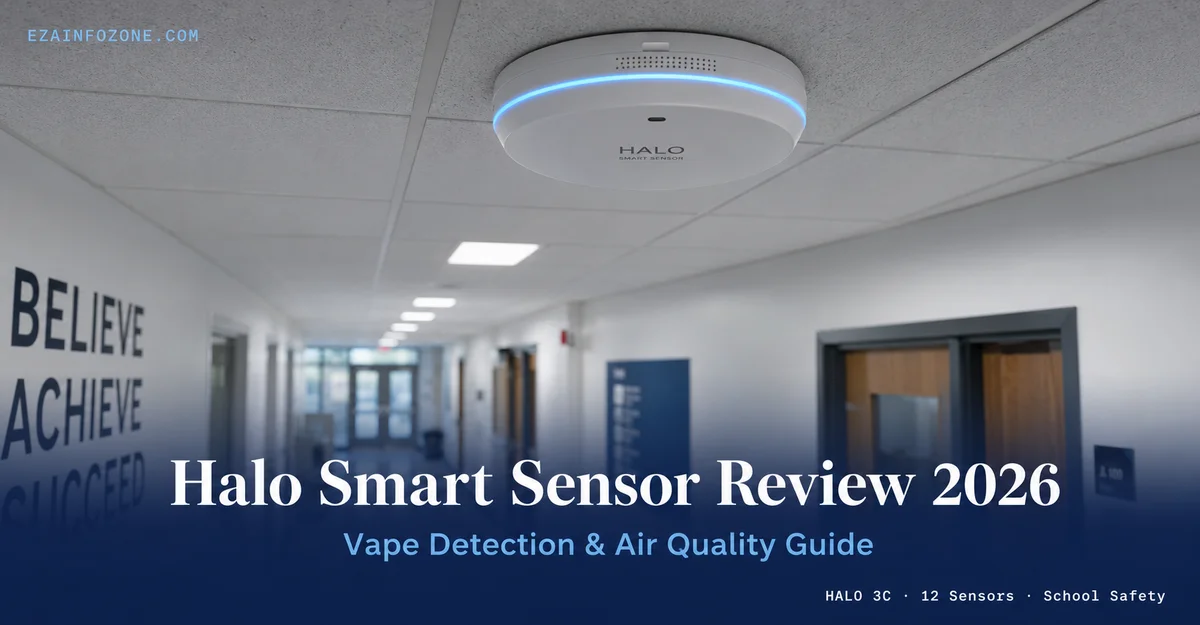
Halo Smart Sensor Review 2026:
Vape Detection, Air Quality & School Safety
The complete guide to the HALO Smart Sensor — how its 12-sensor array detects vaping, THC, aggression and air quality threats, who needs it, and whether it’s worth the investment.
The HALO Smart Sensor (HALO 3C) is an advanced multi-threat detection device by IPVideo Corporation that uses 12 sensors to detect vaping, THC smoke, poor air quality, aggression, and gunshots — without a camera. It is the most widely deployed vape detector in US schools and commercial buildings. Pricing is quote-based; basic alerts require no subscription, while the full cloud dashboard requires an annual HALO Cloud License. Coverage: 144 sq ft per unit at 8-ft ceilings.
What Is the HALO Smart Sensor?
The HALO Smart Sensor is a ceiling-mounted multi-threat detection device manufactured by IPVideo Corporation. Unlike traditional security cameras, HALO uses no video — instead, it deploys an array of chemical, audio, environmental, and motion sensors to detect safety threats in real time, making it ideal for privacy-sensitive spaces like school restrooms, locker rooms, hotel hallways, and hospital wards.
Originally launched as a vape detector, the HALO Smart Sensor has evolved into one of the most comprehensive IoT safety devices on the market. As of 2026, it has won over 75 industry awards and is installed in thousands of school districts across the United States, as well as universities, corporate offices, government facilities, and healthcare buildings.
HALO 3C — Current Generation Specs
The HALO 3C is the current-generation Halo Smart Sensor model. Compared to earlier versions, it adds multicolored LED emergency alerts visible from a distance, an enhanced motion detection system, and a built-in panic button feature that allows anyone in the room to trigger an instant alert. The HALO 3C-PC variant adds a people counting module, useful for occupancy management in corporate offices and public facilities.
12 Sensors: Everything the HALO Can Detect
What sets the HALO Smart Sensor apart from basic vape detectors is its 12-sensor array. Each sensor monitors a different environmental or behavioral signal, and the system uses combinations of hundreds of readings to accurately identify threats — reducing false positives while catching real incidents. Here is what HALO actively monitors:
This multi-sensor approach also means that HALO can work as part of a broader smart home security system or campus-wide security network, integrating with Video Management Systems (VMS) and building management platforms through open API connections.
Best Use Cases for the HALO Smart Sensor
The HALO Smart Sensor is deployed across a wide range of environments. Its camera-free design makes it especially valuable anywhere privacy concerns prevent traditional surveillance.
The most common deployment. HALO is installed in restrooms and locker rooms where cameras are prohibited. School administrators receive instant alerts when vaping is detected, enabling rapid intervention. Districts report a significant drop in vaping incidents within weeks of installation.
Campus-wide deployments cover dormitories, study halls, and sports facilities. THC detection is particularly valuable in states where cannabis is legal but campus use is prohibited, giving administrators clear incident data.
Air quality and CO² monitoring improve workplace health and productivity. The HALO 3C-PC adds people counting for space utilization reporting. Aggression detection adds a layer of workplace safety in high-stress environments.
Hospitals and clinics use HALO to maintain air quality standards in patient areas, detect unauthorized vaping, and monitor for aggressive incidents involving patients or visitors in waiting rooms and corridors.
Apartment buildings and gated communities install HALO in elevators, parking garages, and common areas. Motion detection and aggression monitoring supplement or replace traditional camera coverage in privacy-sensitive zones.
Hotels use HALO in hallways and non-camera zones to enforce no-smoking policies and detect vaping in guest rooms. Real-time alerts allow staff to respond before smoke damage triggers fire suppression systems.
HALO Smart Sensor Installation & Setup
One of HALO’s biggest practical advantages is its straightforward installation. A single CAT5e or CAT6 cable handles both data and power (Power over Ethernet), eliminating the need for separate electrical wiring. Most installations are completed by an IT technician without an electrician.
Plan Placement Locations
Each unit covers 144 sq ft at 8-ft ceiling height. Map out coverage zones — priority areas are restrooms, locker rooms, stairwells, and any enclosed space where incidents are likely. For schools, one unit per bathroom stall cluster is standard.
Run CAT5e or CAT6 Cable
Route a single network cable from your PoE switch to each sensor location. HALO requires no separate power supply — the cable carries both data and the 12V power the device needs. Standard structured cabling is sufficient.
Mount in 5-Inch Ceiling Opening
HALO 3C mounts in a standard 5-inch circular ceiling cutout, similar to a recessed light fitting. The mounting bracket secures the unit flush with the ceiling for a clean, discreet appearance that does not look like a security device.
Connect to Network & Configure
Connect the device to your network via the PoE switch. Access the HALO management interface to configure detection thresholds, alert recipients, and integration settings. For cloud features, activate your HALO Cloud License through the portal.
Set Up Alerts & Integrations
Configure real-time alerts via email, SMS, or push notifications through the HALO Cloud platform. For enterprise deployments, connect HALO to your existing VMS, access control system, or building management platform via the open API.
HALO Smart Sensor Price & Subscription Model
The HALO Smart Sensor price is not publicly listed — it is available by quote only through IPVideo Corporation’s authorized reseller network or directly via halodetect.com. This is standard for commercial-grade security equipment, where pricing varies by order volume, installation complexity, and regional distributor.
For schools, the HALO Smart Sensor is frequently purchased through E-Rate funding, federal Title IV grants, and state school safety grants, which can cover a significant portion of the purchase and installation cost. Many school districts have deployed HALO at zero net cost using these funding mechanisms.
HALO Smart Sensor vs Competitors
The commercial vape detection market has grown significantly since 2020. Here is how the HALO IoT Smart Sensor compares against the most commonly evaluated alternatives: the Triton Sensor and Verkada SV11.
| Feature | HALO 3C | Triton Sensor | Verkada SV11 |
|---|---|---|---|
| Vape Detection | ✓ Yes | ✓ Yes | ✓ Yes |
| THC Detection | ✓ Yes | △ Limited | ✗ No |
| Aggression Detection | ✓ Yes (audio AI) | ✗ No | ✗ No |
| Gunshot Detection | ✓ Yes | ✗ No | ✗ No |
| Air Quality (CO², CO, VOC) | ✓ Full suite | △ Basic | △ Partial |
| Camera-Free | ✓ Yes | ✓ Yes | ✗ Camera included |
| People Counting | ✓ 3C-PC model | ✗ No | ✓ Yes |
| No-Subscription Option | ✓ Basic alerts free | △ Limited | ✗ Subscription required |
| Installation | CAT5e/CAT6 PoE | CAT5e/CAT6 PoE | CAT5e/CAT6 PoE |
| Industry Awards | 75+ awards | N/A | N/A |
The HALO 3C wins the comparison on multi-threat breadth. Triton is a capable focused vape detector but lacks the audio analytics and comprehensive air quality suite. Verkada SV11 integrates with Verkada’s camera ecosystem, making it a strong choice for existing Verkada customers, but it includes a camera and requires a subscription — both factors that can be problematic in privacy-sensitive school environments.
HALO Smart Sensor: Honest Pros, Cons & Verdict
- 12-sensor array — broadest detection on the market
- Distinguishes THC from standard nicotine vape
- Gunshot and aggression detection included
- Camera-free — safe for privacy-sensitive spaces
- No subscription for basic local alerts
- Simple PoE installation — no electrician needed
- 75+ industry awards; proven in thousands of schools
- E-Rate and grant eligible for schools
- Open API for integration with VMS and smart building platforms
- Pricing is not public — requires quote request
- Full cloud features require annual subscription
- 144 sq ft coverage is limited — large spaces need multiple units
- Commercial/institutional focus — may be overkill for a single home
- Requires network infrastructure (PoE switch)
- Higher upfront cost than basic consumer smoke detectors
Is the HALO Smart Sensor Worth It?
For schools, corporate buildings, hospitals, and commercial facilities — yes, the HALO Smart Sensor is absolutely worth the investment. No other single device offers the same breadth of detection: vaping, THC, CO, CO², VOCs, aggression, gunshots, and motion in one camera-free unit. The fact that basic alerts require no subscription makes the ongoing cost manageable, and school districts can often offset the purchase cost through federal and state grants.
For individual homeowners, HALO may be more than needed. A combination of a smart motion sensor, CO detector, and smart lock covers the home security basics at a fraction of the cost. That said, for landlords managing multi-unit residential properties or homeowners who want institutional-grade monitoring, HALO delivers unmatched capability.
Frequently Asked Questions About the Halo Smart Sensor
Building a Complete Smart Home Security System?
The HALO Smart Sensor pairs with smart locks, motion sensors, and security cameras for a layered, comprehensive home and building security setup.
Security Setup Guide → Best Smart Locks 2026 →