Smart Air Purifier with Monitor: Complete Guide to Indoor Air Quality (2026)
Smart Air Purifier with Monitor: Complete Guide to Indoor Air Quality
How smart air purifiers auto-adjust based on real-time sensor data — plus the best models, what pollutants to track, and how to automate your air quality with Home Assistant.
A smart air purifier auto-adjusts fan speed using real-time air quality sensor readings — no manual setting needed. It filters PM2.5 particles, VOCs, and allergens via a True HEPA filter and connects to an app or voice assistant. Entry models start at $99 (Levoit Core 300S); models with a built-in indoor air quality monitor start at $350 (Coway Airmega 400S).
What Is a Smart Air Purifier?
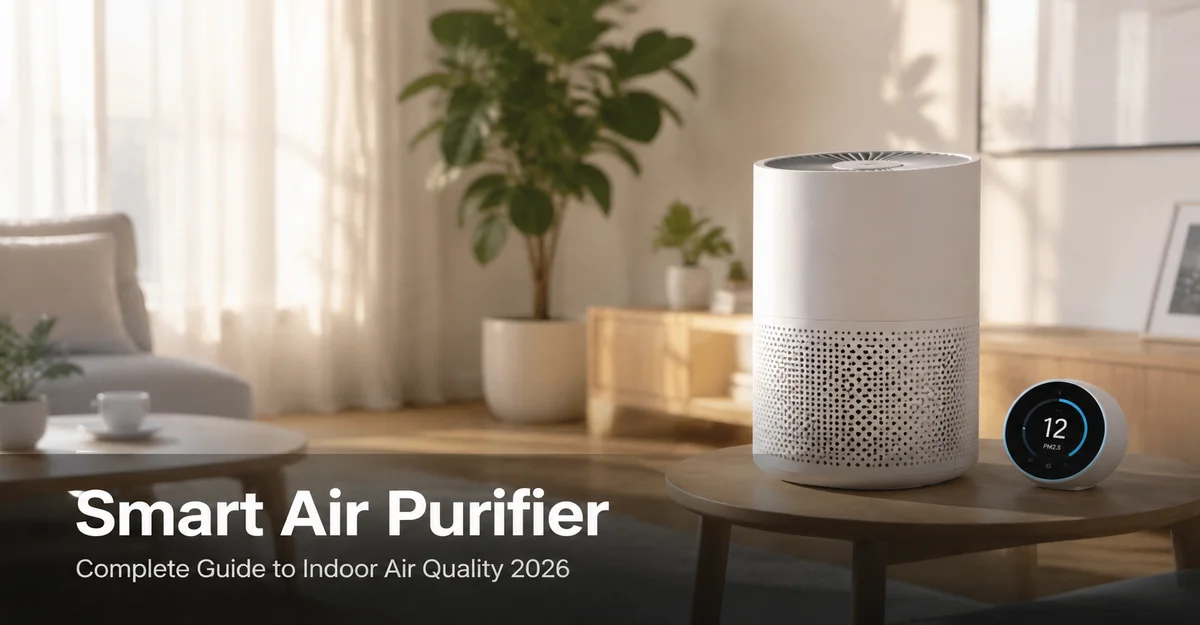
A smart air purifier is an air cleaning device that connects to your home Wi-Fi, monitors indoor pollutant levels via a built-in or paired sensor, and automatically adjusts its fan speed based on the air quality it detects. When pollutant levels rise — from cooking fumes, pet dander, or VOCs from cleaning products — the purifier ramps up to maximum speed without requiring any input from you. When air quality recovers, it drops back to a quiet low setting.
The key component that separates a smart air purifier from a standard one is the PM2.5 laser sensor (and in premium models, VOC and humidity sensors). This sensor continuously samples the air and sends readings to the companion app, where you can view real-time indoor air quality data, historical trends, and filter life remaining. Most smart air purifiers also support Amazon Alexa, Google Home, and Apple HomeKit for voice control and automation.
At the filter level, smart air purifiers use the same technology as traditional models: a True HEPA filter (H13 grade) captures 99.97% of airborne particles 0.3 microns or larger, and an activated carbon layer adsorbs gases including VOCs and odors. What makes them smart is the sensor-driven automation layer built on top.
Smart Air Purifier vs Traditional Air Purifier
Both types use the same HEPA filtration core. The difference is entirely in the sensor, automation, and connectivity layer:
| Feature | Smart Air Purifier | Traditional Air Purifier |
|---|---|---|
| Fan Speed Control | Auto-adjusts via sensor | Manual only |
| Air Quality Display | Real-time PM2.5 / AQI reading | None |
| App Control | Remote via smartphone | Physical controls only |
| Voice Assistant | Alexa / Google Home / Siri | Not supported |
| Filter Alerts | App notification when due | Indicator light only (some models) |
| Scheduling | App-based timer + routines | Physical timer (some models) |
| Home Automation | Home Assistant / Matter compatible | Not possible |
| Energy Use | Lower (runs only when needed) | Fixed (runs at set speed continuously) |
| Price Range | $99–$600+ | $30–$200 |
The auto mode energy saving alone justifies the price difference for most households. A smart air purifier running in auto mode typically runs at low speed for the majority of the day; a traditional purifier left on high runs at full power continuously.
Best Smart Air Purifiers 2026
All four models below use H13 True HEPA filtration, connect via Wi-Fi app, and support at least one major voice assistant. Prices are MSRP as of May 2026:
Levoit Core 300S
The best-selling smart air purifier in the US. Compact 360° air intake design, ultra-quiet at 24 dB on sleep mode, and full VeSync app control with Alexa and Google Home support. Requires a separate indoor air quality sensor for auto mode — pairs with the Levoit Smart Air Quality Sensor (~$30).
- Lowest price in smart class
- Whisper-quiet sleep mode
- Smallest filter replacement cost
- Home Assistant via VeSync
- No built-in air quality sensor
- 219 sq ft coverage only
- Sensor sold separately
Dyson Purifier Cool TP07
The most feature-complete smart air purifier available. Built-in sensors measure PM2.5, PM10, VOCs, NO², humidity, and temperature in real time. The LCD screen shows live AQI. Functions as both a HEPA air purifier and a bladeless fan, making it a year-round appliance.
- All-in-one purifier + fan
- Best sensor suite in class
- Real-time VOC + NO² display
- Alexa, Google, Siri compatible
- Most expensive option
- Filter replacement ~$70+/yr
- Loud at max airflow speed
BLUEAIR Blue Pure 211i Max
Highest CADR in this comparison at 350 CFM — covers up to 635 sq ft. Uses HEPASilent Ultra technology (electrostatic + mechanical filtration) that captures 99.97% of particles at lower motor resistance, making it exceptionally quiet for its size. Compatible with Alexa, Google Home, and Apple HomeKit.
- Highest CADR in mid-range
- Ultra-quiet for room size
- Apple HomeKit support
- Washable pre-filter
- No built-in air quality sensor
- Requires separate home air quality monitor for auto mode
Coway Airmega 400S
The best smart air purifier for open-plan living spaces up to 1,560 sq ft. Built-in real-time air quality indicator (color LED + PM2.5 numerical display), dual-sided filter system, and auto mode that responds to detected particles within 30 seconds. Compatible with Amazon Alexa and SmartThings.
- Largest room coverage (1,560 sq ft)
- Built-in PM2.5 sensor + LED display
- Dual filter system (2 sides)
- SmartThings integration
- Bulky footprint (14.8 x 14.8 in)
- No Google Home or Apple HomeKit
Indoor Air Quality Monitor: What to Measure
A home air quality monitor measures the specific pollutants a HEPA filter can and cannot address. Understanding each reading helps you decide when to run your smart air purifier at full speed, when to open a window, and when a reading requires immediate action. The EPA’s National Ambient Air Quality Standards define the safe limits below:
| Pollutant | Safe Level | Action Level | Removed by Purifier? | Best Monitor |
|---|---|---|---|---|
| PM2.5 Fine particles <2.5 microns | <12 μg/m³ | >35 μg/m³ | Yes — True HEPA | IQAir AirVisual Pro, Govee H5179 |
| VOCs Gases from cleaners, paints, furniture | <0.3 mg/m³ | >1.0 mg/m³ | Partially — carbon filter | Dyson (built-in), Airthings Wave Plus |
| CO² Carbon dioxide from breathing | <1,000 ppm | >2,000 ppm | No — ventilation required | Aranet4, Inkbird CO2 sensor |
| Humidity Moisture level in air | 30–50% | >60% (mold risk) | No — use a dehumidifier | Most smart purifiers (built-in) |
| PM10 Coarse particles: dust, pollen | <54 μg/m³ | >155 μg/m³ | Yes — True HEPA | IQAir AirVisual Pro, Coway (built-in) |
A standalone smart air quality monitor like the IQAir AirVisual Pro ($269) gives the most accurate PM2.5, CO², and AQI data of any consumer device. For budget-conscious buyers, the Govee H5179 ($49) covers PM2.5, CO², temperature, and humidity and integrates directly with Home Assistant via Bluetooth. See our smart home energy management guide for how to link air quality data to your HVAC system.
Indoor Air Pollutants: Sources & How to Reduce Them
Indoor air is often 2–5 times more polluted than outdoor air according to the EPA, because pollutants accumulate in enclosed spaces with limited ventilation. A smart air purifier addresses the particle-based pollutants below; for gas-based pollutants, ventilation is the primary solution. See our dedicated indoor air quality guide for a room-by-room breakdown of pollutant sources:
| Pollutant | Primary Sources | Smart Purifier Effective? | Additional Fix |
|---|---|---|---|
| PM2.5 Fine Particles | Candles, incense, cooking smoke, outdoor traffic | Yes — H13 HEPA captures 99.97% | Eliminate candle/incense use indoors |
| Pet Dander | Cats, dogs, birds — shed skin cells, saliva proteins | Yes — HEPA + pre-filter | Vacuum weekly, bathe pets regularly |
| Dust Mite Debris | Bedding, carpets, upholstered furniture | Yes — HEPA captures fecal particles | Allergen-proof mattress covers |
| Mold Spores | Bathrooms, basements, leaking walls (humidity >60%) | Yes — HEPA captures spores | Fix moisture source; dehumidify |
| VOCs | Cleaning sprays, paints, adhesives, new furniture off-gassing | Partially — activated carbon only | Ventilate after cleaning; air new furniture outdoors |
| Cooking Fumes | Frying, grilling, gas stove combustion | Partially — particles yes, gas no | Use range hood during cooking |
| CO² | Human respiration, gas appliances | No — not a filterable gas | Open windows; install HRV/ERV ventilation |
Smart Air Purifier Home Assistant Integration
All four purifiers reviewed in this guide can be integrated with Home Assistant, enabling automations that no native app supports — such as automatically boosting your smart air purifier to full speed when your home air quality monitor detects PM2.5 above 25 μg/m³, or shutting it off when everyone leaves home.
| Purifier Brand | HA Integration | Method | Local or Cloud |
|---|---|---|---|
| Levoit (VeSync) | VeSync integration | HACS or built-in | Cloud |
| Dyson | Dyson Local integration | HACS | Local (MQTT) |
| BLUEAIR | Via Alexa / Google HA bridge | Cloud-to-cloud | Cloud only |
| Coway | SmartThings integration | Built-in HA SmartThings | Cloud |
For the most reliable Home Assistant automation, the Dyson Purifier Cool uses a local MQTT connection via the Dyson Local integration — it works without internet access and responds in under 1 second. Levoit’s VeSync integration is cloud-based but well-maintained and supports fan speed, mode, and child lock control from HA.
A useful automation example: trigger your smart air purifier to boost when the Govee H5179 CO2 monitor for home reports above 1,200 ppm (stale air signal) and PM2.5 exceeds 20 μg/m³ simultaneously. This targets both particle and ventilation events in one rule. Full automation templates are available in our Home Assistant setup guide.
Smart Air Purifier Buying Guide: 4 Decisions Before You Buy
Before selecting a smart air purifier, confirm these four specifications to avoid buying a device that is underpowered for your space or missing the sensors your automation requires:
Calculate the CADR You Need
Multiply your room’s square footage by 0.67 to get the minimum CADR in CFM. A 300 sq ft bedroom needs CADR ≥ 200 CFM. A 600 sq ft living room needs ≥ 400 CFM. For allergy sufferers, the AHAM recommends choosing a device rated for a room 20% larger than your actual space.
Check for Built-In Sensor vs External
Only the Dyson TP07 and Coway Airmega 400S include built-in PM2.5 sensors that enable true auto mode. Levoit Core 300S and BLUEAIR 211i Max require a separate indoor air quality monitor or sensor accessory for the auto adjustment feature to function.
Factor in Annual Filter Cost
The purchase price is not the total cost. Levoit replacement filters cost ~$20/year. BLUEAIR filters cost ~$50. Coway costs ~$60. Dyson replacement filters run ~$70+. Over 5 years, a Levoit Core 300S costs $199 total; a Dyson TP07 costs $900+. Match filter cost to your budget before committing.
Confirm Your Smart Home Ecosystem
If you use Apple HomeKit, BLUEAIR Blue Pure 211i Max is the only model here with native HomeKit support. For Google Home households, Levoit and Dyson both integrate. For Home Assistant users who want local-only control, Dyson’s MQTT-based Dyson Local integration is the most reliable option in this group.
For more guidance on building a complete smart home setup, visit our smart home automation hub for device compatibility charts and room-by-room setup guides.
Frequently Asked Questions — Smart Air Purifier
Automate Your Indoor Air Quality
Connect your smart air purifier and indoor air quality monitor to Home Assistant for hands-free air quality control — auto boost, scheduling, and real-time alerts in one dashboard.
Set Up Home Assistant