How to Learn Morse Code: Step by Step Guide for Beginners
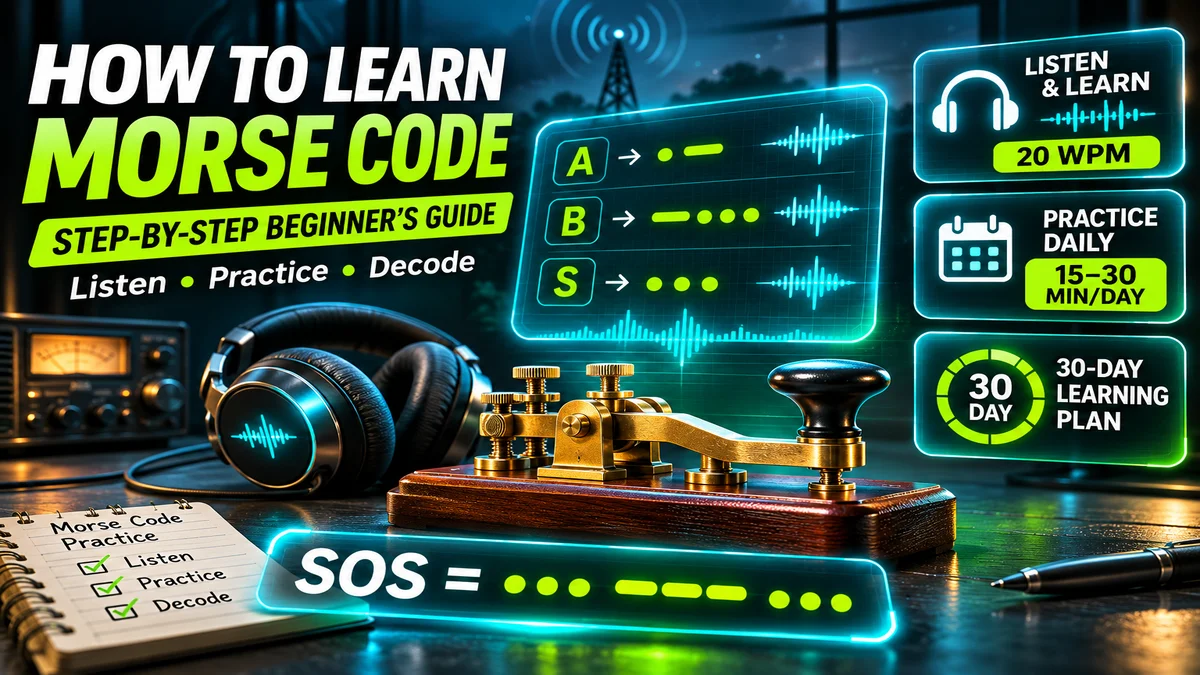
Most people who give up on Morse code learned it the hard way, from a chart. This guide shows the method that actually works, by sound, with a step by step plan, a 30-day schedule and the best free resources.
Quick answer: the best way to learn Morse code is by sound, not by memorizing a chart. Listen to each letter at a normal speed of about 18 to 20 words per minute, learn two letters first (the Koch method), and add a new one only when you copy about 90% correctly. Practice 15 to 30 minutes a day, and most learners can recognize the whole alphabet in a few weeks.
In this guide
- Is Morse code hard to learn?
- Benefits of learning Morse code
- Morse code basics before you start
- How to learn Morse code, step by step
- Learning methods compared
- How long does it take to learn Morse code?
- A 30-day practice plan
- How to memorize Morse code
- Tips, tricks and hacks to learn faster
- Practice words for beginners
- How to do Morse code: write, tap, flash and talk
- How to learn to send Morse code
- Best Morse code learning resources and apps
- How to teach Morse code
- Learning Morse code for ham radio
- Common mistakes
- Practice test
- FAQs
Learning Morse code is easier than it looks, as long as you start the right way. Thousands of people learn it every year, for amateur radio, for survival skills, for accessibility, or just for fun. The ones who succeed almost all learn it as a sound, the way you’d learn the words of a new language, instead of as a list of dots and dashes.
This tutorial is written for complete beginners. It covers the basics, a step by step method, a realistic timeline, a 30-day plan, tips to learn faster, and the free tools that work best. You can use our free Morse code translator alongside it to hear any letter or word at the speed you’re practicing.
Is Morse Code Hard to Learn?
It isn’t hard, but it does take regular practice. There are only 26 letters, 10 numbers and a handful of punctuation marks to learn, which is far less than a new language. The challenge is speed: you need to recognize each sound instantly, without stopping to think.
The biggest reason people find it hard is the way they start. If you learn from a printed chart, your brain learns “dot dash” as a picture, then has to translate every sound back into that picture. That extra step is slow and creates a ceiling most learners get stuck at, often around 5 to 10 words per minute. Learning by sound from day one removes that step.
So the honest answer: it’s easy to start, it takes a few weeks of daily practice to know the alphabet, and it takes a few months to copy comfortably at conversation speeds.
Benefits of Learning Morse Code
Why learn a code that’s more than 180 years old? Because the advantages are real: it’s still useful, and it’s a skill that never needs a battery-hungry device.
- An emergency skill. You can signal SOS with a flashlight, a whistle, a mirror or by tapping, even when a phone has no signal.
- Ham radio. It lets you make contacts around the world with simple, low-power radios.
- Accessibility. It can be typed with one or two switches, which helps some people with limited movement use phones and computers.
- Quiet communication. Light, vibration and touch let you send messages without making a sound.
- A fun challenge. Secret notes, puzzles, escape rooms and coded jewelry are much more fun when you can read them yourself.
Morse Code Basics Before You Start
A few fundamentals will make every lesson easier.
- Dits and dahs. A dot is called a “dit” and a dash is a “dah”. Saying them out loud helps you think in sound. A, for example, sounds like “di-dah” (
.-). - Timing is fixed. A dah is three times as long as a dit. The gap inside a letter is one dit long, the gap between letters is three, and the gap between words is seven.
- Speed is measured in WPM. Words per minute are counted with the standard word “PARIS”. At 20 WPM, a single dit lasts 60 milliseconds.
- Character speed vs overall speed. You can play each letter fast while adding extra space between letters. This is the key to learning by sound, and we’ll use it below.
You don’t need to memorize the alphabet before you start. You’ll learn it letter by letter, by ear, in the steps that follow. If you want to see the full Morse code alphabet first, it’s on our Morse code translator page.
How to Learn Morse Code, Step by Step
This is the method most experienced operators recommend. It combines two proven techniques, the Koch method and Farnsworth spacing.
- Set the character speed to 18 to 20 WPM. At this speed each letter is too fast to count, so your brain has to hear it as one sound. That’s exactly what you want.
- Add extra spacing between letters. Keep the letters fast but stretch the gaps, so your overall speed is slow, around 5 to 10 WPM. This is Farnsworth spacing, and it gives you time to think between letters.
- Start with just two letters. Many courses begin with K (
-.-) and M (--). Listen to random groups of those two letters and write down what you hear. - Add a letter at 90%. When you copy about 90% of the characters correctly, add one new letter. This is the Koch method. It keeps every session at the edge of what you can do.
- Write, don’t think. Write each letter as soon as you recognize it. If you miss one, leave a gap and move on. Stopping to work out a missed letter makes you miss the next three.
- Practice every day. Fifteen to thirty minutes a day beats two hours once a week. Short, regular sessions build the instant recall you need.
- Add numbers and punctuation. After the alphabet, learn 0 to 9, then the period, comma, question mark and slash.
- Move from letters to words. Start copying common words and short sentences. Over time you’ll begin to hear whole words instead of single letters.
Tip: you can make your own practice audio. Type a few random letters into the Morse code translator, set the speed to 20 WPM, and press Play or Download .wav to listen on the go.
The Koch Method, Explained
The Koch method was developed by German psychologist Ludwig Koch in the 1930s. Instead of learning slowly and speeding up later, you learn at full character speed from the first lesson, but with only two letters. Each time you reach about 90% accuracy, you add one more. Because you never practice slowly, you never build the slow “counting” habit that you’d have to unlearn later.
Farnsworth Spacing, Explained
Farnsworth spacing, named after Donald Farnsworth, sends each character at a normal speed but adds longer gaps between characters and words. For example, letters might be sent at 18 WPM while the overall speed is only 8 WPM. As you improve, you shrink the gaps until the overall speed matches the character speed. Koch and Farnsworth work well together, and most learning apps let you set both speeds.
Morse Code Learning Methods Compared
There are several ways to learn. Here’s how they stack up, with the pros and cons of each.
| Method | How it works | Pros | Cons |
|---|---|---|---|
| Koch method | Full speed, two letters, add one at 90% | Builds instant recognition, no bad habits | Feels hard in the first few sessions |
| Farnsworth spacing | Fast letters, long gaps | Time to think, easy to speed up later | Needs an app or tool that supports it |
| Visual mnemonics | A picture for each letter’s shape | Fun, quick to recognize letters on screen | Slow when listening, still a visual habit |
| Chart memorization | Learn dots and dashes from a table | Fast to start | Creates a speed ceiling, hard to unlearn |
| Live classes | Group lessons with an instructor | Structure, feedback and motivation | Fixed schedules, may need a radio club |
For most beginners, the best strategy is Koch with Farnsworth spacing for learning, plus a live class or practice group later to stay motivated.
How Long Does It Take to Learn Morse Code?
It depends on your goal and how often you practice. These are typical ranges reported by learners practicing 15 to 30 minutes a day by sound:
| Goal | Typical time |
|---|---|
| Recognize SOS and a few letters | One day |
| Recognize the whole alphabet by sound | A few weeks |
| Copy letters and numbers at 10 to 15 WPM | About two to three months |
| Copy comfortably at 20 WPM or more | Several months to a year |
Everyone learns at a different pace, and plateaus are normal. If you get stuck at one speed for a while, keep practicing a little above it. The jump usually comes suddenly.
A 30-Day Morse Code Practice Plan
Use this plan as a checklist for your first month. Each session is 15 to 30 minutes.
| Week | Focus | Goal by the end of the week |
|---|---|---|
| Week 1 | Set 20 WPM characters with Farnsworth spacing. Start with two letters and add more at 90% accuracy. | About 6 to 8 letters |
| Week 2 | Keep adding letters. Review your weakest letters at the start of each session. | About 15 to 18 letters |
| Week 3 | Finish the alphabet, then start the numbers 0 to 9. | All 26 letters, a few numbers |
| Week 4 | Numbers, common punctuation, and short real words. | Copy simple words and numbers |
Don’t worry if you fall behind the plan. Accuracy matters more than speed, and moving on too early only makes the next letters harder.
How to Memorize Morse Code (Without a Chart)
Memorizing Morse code is different from memorizing a phone number. You’re not storing dots and dashes, you’re training your ear to link a sound to a letter. That’s why the best memory method is repetition by sound, spread over many short sessions.
- Hear the letter, say the letter. Play a letter at 20 WPM and say its name out loud as soon as it ends. Speed matters more than perfection.
- Learn in pairs that sound different. Letters that sound alike, like S
...and H...., are easier to separate once you know both well. Add similar letters a few days apart. - Review your weakest letters first. Start each session with the two or three letters you missed most last time.
- Use spaced repetition. Revisit letters after a day, then after a few days, then after a week. Most learning apps do this for you.
- Use visual tricks only as a backup. Picture mnemonics help some learners recognize letters on screen, but they slow you down when listening. Use them to recall a forgotten letter, not as your main method.
How to Learn Morse Code Fast: Tips, Tricks and Hacks
These strategies help you learn faster without picking up bad habits.
- Never count dits. If you catch yourself counting, the character speed is too slow. Turn it up.
- Say the sound, not the symbols. Think “dah-di-dah” for K, not “dash dot dash”.
- Use the mirror pairs. Some letters are others backwards: A
.-and N-., D-..and U..-, G--.and W.--. Knowing the pairs helps when you’re stuck. - Learn the count-up letters. E, I, S and H are one to four dits. T, M and O are one to three dahs.
- Practice in short bursts. Two 10-minute sessions are often better than one 20-minute session.
- Listen in spare moments. Download practice audio and play it on a walk or a commute.
- Feel it. On a phone, turn on vibrate in the translator to feel the rhythm without sound.
- Copy real words early. Once you know about 15 letters, practice with words made from those letters. Real words are more motivating than random groups.
Morse Code Practice Words for Beginners
Once you know a handful of letters, practice with real words. These examples use only common early letters (E, T, A, I, N, M, S and O), so you can try them in your first week or two. Cover the codes, play each word in the translator, and write down what you hear.
| Word | Morse code | Word | Morse code |
|---|---|---|---|
| TEN | - . -. | EAT | . .- - |
| SIT | ... .. - | TEAM | - . .- -- |
| MEAT | -- . .- - | MAIN | -- .- .. -. |
| NOTE | -. --- - . | STONE | ... - --- -. . |
As you learn more letters, add your name, your city and common words like THE, AND and YOU. The translator also works as a Morse code generator, so you can turn any word list into practice audio.
How to Do Morse Code: Write, Tap, Flash and Talk
Once you know some letters, here’s how to use Morse code in several ways. The rules are the same each time: short and long signals, a small gap inside a letter, a medium gap between letters, and a long gap between words.
How to Write Morse Code on Paper
Write a dot as a period and a dash as a hyphen. Leave one space between letters and use a slash, or a wider gap, between words. “Hi you” becomes .... .. / -.-- --- ..-. Keep dots small and dashes clearly longer, so nobody mixes them up.
How to Tap Morse Code
Tapping only works if the rhythm is clear. Use a quick tap for a dot and press and hold for a dash, about three times as long. Many people find it easier to tap two different ways instead: a light tap with a fingernail for a dot and a knock with a knuckle for a dash. Pause a little between letters and longer between words.
How to Signal Morse Code With a Light
Use a short flash for a dot and a long flash, about three times as long, for a dash. Keep the light off for one dot length between signals, three between letters and seven between words. A flashlight works well at night, and a mirror catching the sun works in the day.
How to Talk in Morse Code
You can even “speak” Morse code. Say “dit” for a dot and “dah” for a dash, and drop the final T of a dit inside a letter. So A is “di-dah”, K is “dah-di-dah” and SOS is “di-di-dit dah-dah-dah di-di-dit”. It’s a handy way to practice when you don’t have a device.
How to Learn to Send Morse Code
Receiving comes first, because you can’t send well until you know how good code sounds. Once you can copy the alphabet, start sending and follow these best practices.
- Pick a key. A straight key goes up and down and you make every dit and dah by hand. A paddle with an electronic keyer makes the dits and dahs for you, so you only control the rhythm. Many beginners start with a straight key or a practice oscillator.
- Send what you can copy. Only send letters you already recognize by ear.
- Get the spacing right. Most sending mistakes are gaps, not dits and dahs. Keep letter gaps and word gaps clear.
- Compare with a reference. Play the same word in the Morse code translator, then send it and compare the rhythm.
- Record yourself. Listen back later. If you can’t copy your own sending easily, slow down.
You can also practice sending without any gear. Tap on a table, flash a flashlight, or use the Morse code keyboard in Google’s Gboard on your phone.
Best Morse Code Learning Resources and Apps
These free tools and resources are popular with beginners and experienced operators alike.
- LCWO (Learn CW Online): a free website that teaches Morse code with the Koch method, tracks your progress, and lets you set character and Farnsworth speeds.
- CW Academy by CWops: free online classes for beginners and intermediate operators, taught live by volunteer instructors.
- ARRL code practice: the American Radio Relay League’s station W1AW sends scheduled code practice at several speeds.
- Morse Code Ninja: free practice audio for listening drills at many speeds.
- Google’s tools: Gboard on Android and iPhone includes a Morse code keyboard, and Google built a picture-based Morse learning game with assistive technology experts.
- EZA Morse Code Translator: play any text as Morse code at 5 to 40 WPM, change the tone, flash a light, vibrate, or download a .wav file for offline practice.
What about Duolingo? Duolingo doesn’t offer a Morse code course. People have petitioned for one, but for now a dedicated tool or class is the best alternative.
Hear any letter or word right now. Type it in our free Morse code translator, set your practice speed, and press Play, or download it as audio.
Open the Morse Code TranslatorMorse Code Classes, Courses and Trainers
If you learn better with structure, try a class, a course or a formal Morse code training program:
- Online classes: CW Academy runs free, instructor-led Morse code classes over several weeks, with small groups and homework.
- Local radio clubs: many amateur radio clubs offer beginner Morse code lessons and slow-speed practice nights.
- Morse code trainer apps: look for an app that uses the Koch method, lets you set both speeds, and tracks the letters you miss. That’s what makes daily Morse code practice efficient.
How to Teach Morse Code to Kids or a Group
Teaching Morse code works best when it feels like a game. These ideas work for kids, scout groups and classrooms:
- Start with something meaningful. SOS and each learner’s own name give a quick win in the first lesson.
- Teach the sound, not the chart. Have everyone say “di-dah” out loud before they ever see a dot or a dash.
- Use simple games. Flashlight messages across a dark room, tapping secret notes on a desk, or a Morse code treasure hunt keep it fun.
- Add a few letters at a time. Two or three new letters per lesson is plenty. Review the old ones first.
- Celebrate small wins. Decoding a first word, like TEAM or STONE from the practice list above, is a big motivator.
Learning Morse Code for Ham Radio
Many people pick up Morse code to use it on amateur (ham) radio, where it’s called CW. You no longer need it for a license: the US dropped the code test for amateur licenses in 2007. But CW is still popular because it gets through weak and noisy signals with simple, low-power equipment.
On the air, operators use abbreviations to keep messages short. A few you’ll hear right away:
| Abbreviation | Meaning | Morse code |
|---|---|---|
| CQ | Calling any station | -.-. --.- |
| DE | From (this is) | -.. . |
| QTH | My location | --.- - .... |
| 73 | Best regards | --... ...-- |
| 88 | Love and kisses | ---.. ---.. |
A local radio club is one of the best places to learn. Many clubs run beginner classes and slow-speed practice sessions on the air.
Common Mistakes When Learning Morse Code (and How to Fix Them)
- Learning from a chart. Why it happens: charts are the first thing you see online. How to avoid it: learn every letter by sound first. Fix: switch to a Koch course, even if it feels slower at first.
- Practicing too slowly. Why it happens: slow feels easier. How to avoid it: keep characters at 18 to 20 WPM. Fix: slow the overall speed with Farnsworth spacing instead.
- Moving on too early. Why it happens: it’s exciting to add letters. How to avoid it: wait for about 90% accuracy. Fix: go back one lesson and rebuild accuracy.
- Stopping on missed letters. Why it happens: wanting a perfect copy. How to avoid it: leave a gap and keep going. Fix: practice with longer groups so you get used to letting misses go.
- Long, rare sessions. Why it happens: busy weeks. How to avoid it: practice a little every day. Fix: set a daily 15-minute reminder.
Practice Test: Can You Decode These?
Try these without the translator, then open the answers. If you’ve only learned a few letters so far, come back to this test later.
-.---.... ..- . ... --.-. --- -.. ..-.. . .- .-. -.
Show the answers
- K
- M
- HI
- TEST
- CODE
- LEARN
How to Learn Morse Code: FAQs
Is it easy to learn Morse code?
It is easier than most people expect. There are only 26 letters, 10 numbers and a few symbols to learn. The key is learning by sound instead of from a chart. With 15 to 30 minutes of daily practice, most beginners can recognize the whole alphabet within a few weeks.
What is the best way to learn Morse code?
Learn it by sound with the Koch method and Farnsworth spacing. Play each letter at about 18 to 20 words per minute, add extra space between letters, start with two letters, and add one more each time you reach about 90 percent accuracy. Practice a little every day.
How long does it take to learn Morse code?
Most learners who practice 15 to 30 minutes a day by sound can recognize the alphabet in a few weeks and copy at 10 to 15 words per minute in about two to three months. Reaching 20 words per minute or more usually takes several months to a year.
How do you memorize Morse code?
Memorize it by sound, not by sight. Play each letter at about 20 words per minute, say the letter out loud as soon as you hear it, review your weakest letters first, and revisit old letters after a day and again after a week. Short daily sessions work best.
How do you say hi in Morse code?
Hi in Morse code is .... .. which is four dits for H, a short gap, then two dits for I. It is a great first word to learn, because H and I belong to the easy count-up group of letters made only of dits.
Can you say I love you in Morse code?
Yes. I love you in Morse code is .. / .-.. --- ...- . / -.-- --- ..- with a slash between the words. Radio operators also use 88, sent as ---.. ---.., as a short way to say love and kisses at the end of a message.
Does Duolingo teach Morse code?
No. Duolingo does not offer a Morse code course, although people have asked for one. Free tools such as LCWO, CW Academy classes, Morse Code Ninja practice audio and the Morse code keyboard in Google Gboard are good ways to learn instead.
What is the best app to learn Morse code?
Choose any app that uses the Koch method and lets you set both character speed and Farnsworth spacing. LCWO is a popular free website that does both. For quick listening practice, you can also play or download audio from a Morse code translator.
Should I learn Morse code from a chart?
No. A chart teaches you to see dots and dashes, so you have to translate every sound into a picture first. That slows you down and creates a speed ceiling. Use a chart only to look up a letter you forgot, and learn everything else by sound.
How do you write Morse code on paper?
Write a dot as a period and a dash as a hyphen, with one space between letters and a slash between words. For example, hi you is written as .... .. / -.-- --- ..- so anyone reading it can see exactly where each letter and word ends.
Can you learn Morse code by tapping?
Yes. Tapping on a table or a phone screen is a good way to practice sending once you know the sounds. Google Gboard includes a Morse code keyboard for tapping on a phone, and the vibrate option in a translator lets you feel the rhythm.
What speed should a beginner use?
Set the character speed to about 18 to 20 words per minute so you cannot count dits, and use Farnsworth spacing to slow the overall speed to around 5 to 10 words per minute. As you improve, shrink the gaps until both speeds match.
Do you need Morse code for a ham radio license?
No. The United States dropped the Morse code test for amateur radio licenses in 2007. Many operators still learn it because Morse code, called CW on the air, gets through weak and noisy signals with simple equipment.
How do you teach Morse code to kids?
Make it a game. Start with SOS and the name of each child, teach the sounds by saying di and dah out loud, then add two or three letters per lesson. Flashlight messages, tapping secret notes and Morse code treasure hunts keep kids interested.
The Bottom Line
The best way to learn Morse code is by sound: fast letters, slow spacing, and one new letter at a time once you reach about 90% accuracy. Practice 15 to 30 minutes a day, use the 30-day plan as your checklist, and lean on free tools like LCWO, CW Academy and our Morse code translator for practice audio. You’ll know the alphabet in a few weeks, and with steady practice you’ll be copying real messages within a few months.